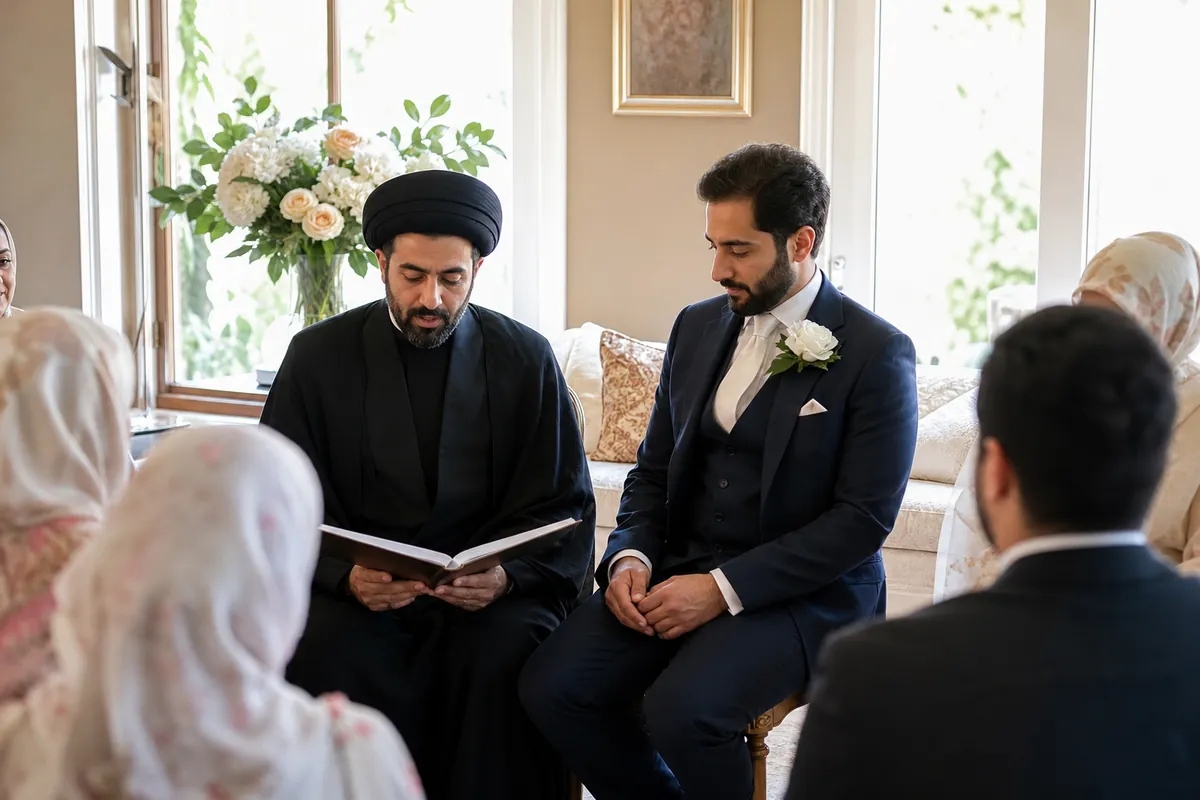
Shia Muslim marriage follows the Jafari (Twelver) school of jurisprudence, which shares the core of the Nikah with Sunni practice but differs on the Arabic sigha, witnesses and the wali. This guide explains those points neutrally for Shia couples and families in the UK, and outlines how a permanent Shia Nikah is performed and registered in Pakistan.
Executive Summary: Shia Muslim Marriage in Brief
Quick answer: a permanent Shia Muslim marriage is formed by an Arabic offer and acceptance, with agreed mahr and the bride's free consent; witnesses are generally recommended rather than required, and scholars differ on the wali for a first-time bride. In Pakistan it is registered on the same Nikah Nama as any Muslim marriage.
What the Guide and Our Service Cover
The guide describes Jafari positions neutrally and issues no rulings. Online Nikah UK, advocate-led since 1985, coordinates a Shia Nikah Khawan and witnesses in Pakistan, prepares the Nikah Nama and handles registration, so that a Shia Muslim marriage is properly recorded under Pakistani law.
Who Needs This Guidance
It is written for Shia couples and families in the UK, the UAE and the wider diaspora, especially where a spouse or relatives live in Pakistan. It also helps mixed Sunni and Shia families see where practice differs before a Shia Muslim marriage is arranged.
Fees and Timescales
We publish no fixed fees; the fee is quoted after we review both parties' documents and confirm whether a wakeel, attestation or translation is needed. Arranging and registering a Shia Muslim marriage is usually a matter of weeks, depending on attestation, availability and registration; never guaranteed.
How to Start With Our Team
To open a Shia Muslim marriage file, send a WhatsApp message to +92 316 6644789 with both parties' passports or CNIC/NICOP details and proof of marital status. Our Pakistan offices are in Karachi (Gulistan-e-Jauhar (head office) and DHA Phase 7) and Islamabad, and we have no UK office. Calls are answered from 10 am to 10 pm Pakistan time; WhatsApp runs 24/7.
Jafari Fiqh, the Marja and Shia Muslim Marriage
Most Shia Muslims in Pakistan and the UK follow the Jafari school, named after Imam Jafar al-Sadiq, and many follow a chosen marja (marja al-taqlid), a senior living jurist such as Ayatollah Sistani or Ayatollah Khamenei. Detailed rulings on Shia Muslim marriage can differ between maraji.
For that reason, this page describes commonly held positions rather than issuing rulings. Couples should confirm the details of their Shia Muslim marriage with a qualified scholar or the office of their marja, particularly on the wali and the wording of the contract.
Key Differences From Hanafi Practice in Pakistan
Most Sunni Muslims in Pakistan follow the Hanafi school, so families often compare the two. The table compares commonly held positions on Shia Muslim marriage and Hanafi practice in simplified form; individual scholars may differ.
| Point | Jafari (Shia) View | Hanafi (Sunni) View |
|---|---|---|
| Contract wording | Arabic sigha generally required where the parties or their wakeels can recite it | Any clear words understood by the parties |
| Witnesses to the Nikah | Generally recommended, not a condition of a permanent marriage | A condition: two men, or one man and two women |
| Wali for a first-time adult bride | Scholars differ; many advise the father's or paternal grandfather's permission | An adult woman may generally contract her own marriage |
| Witnesses to a divorce | Two just male witnesses are a condition | Not a condition of validity |
| Temporary marriage (mut'ah) | Regarded as permissible in Twelver jurisprudence | Regarded as not permitted |
Step by Step: How a Permanent Shia Muslim Marriage Is Performed
A permanent marriage (nikah daim) normally follows the sequence below. It is a general outline of common practice; the officiating scholar guides the details for each Shia Muslim marriage according to the marja the couple follow.
- Confirm both parties' free consent and, for a first-time bride, the wali position of her marja.
- Agree the mahr precisely, in money, gold or the mahr al-sunnah.
- Appoint wakeels where the parties will not recite the sigha themselves.
- Recite the sigha: the bride's side makes the offer and the groom's side accepts.
- Complete and sign the Nikah Nama with witnesses present.
- Register the Shia Muslim marriage with the Union Council and obtain the NADRA certificate.
The Arabic Sigha, With Transliteration
Most Jafari scholars hold that the sigha should be recited in correct Arabic, in the past tense, where the parties or their wakeels are able; many allow a translation if neither can. The examples below are commonly cited forms, and the officiating scholar confirms the exact wording for each Shia Muslim marriage.
| Who speaks | Transliteration | English meaning |
|---|---|---|
| Bride, to the groom | Zawwajtuka nafsi ala al-sadaq al-malum | I have married myself to you on the agreed mahr |
| Groom, in reply | Qabiltu al-tazwij | I accept the marriage |
| Bride's wakeel, to the groom's wakeel | Zawwajtu muwakkilati muwakkilaka ala al-sadaq al-malum | I have married my principal to your principal on the agreed mahr |
| Groom's wakeel, in reply | Qabiltu li-muwakkili al-tazwij ala al-sadaq al-malum | I accept the marriage for my principal on the agreed mahr |
Who Solemnises Your Shia Muslim Marriage in Pakistan
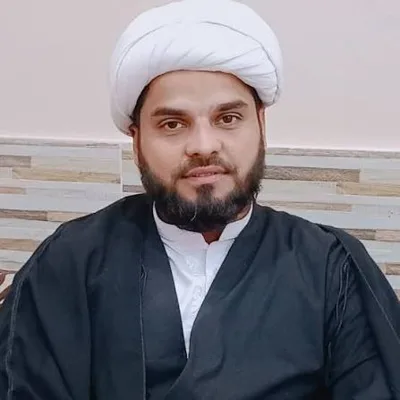
Allama Tariq Hussain Mashhadi
Shia (Jafari) Nikah Khawan
Allama Tariq Hussain Mashhadi performs the Shia Muslim marriage ceremony for our clients in Pakistan, reciting the Arabic sigha in the Jafari way. Where a couple follows a particular marja, please tell us beforehand so the wording and conditions can be checked. The Nikah is then recorded on the Nikah Nama and registered with the Union Council through a licensed Nikah Registrar.
Online Shia Muslim Marriage by Wakalah
Appointing representatives (wakalah) is widely accepted in Jafari fiqh, and it is common in Pakistan for two scholars to recite the sigha as wakeels, one for each party. This makes an online or long-distance Shia Muslim marriage possible where one spouse lives abroad.
The party abroad normally signs a power of attorney appointing the wakeel for the Shia Muslim marriage, which is then attested at a Pakistani mission or apostilled for use in Pakistan; check the mission's current services and jurisdiction. A video link may let the family follow the ceremony, but the wakalah carries the contract.
Witnesses and Wali Consent in a Jafari Nikah
In Jafari fiqh, witnesses at a permanent Nikah are generally regarded as recommended (mustahab) rather than a condition of validity, though two just witnesses are required for a divorce. In practice, witnesses are almost always present in Pakistan, because the Nikah Nama records their details and makes a Shia Muslim marriage easier to prove.
For an adult woman marrying for the first time, scholars differ: some require the permission of her father or paternal grandfather, others hold she may marry independently, and many, including in commonly cited rulings of Ayatollah Sistani, advise obtaining it as a precaution. Her own free consent is essential in every Shia Muslim marriage.

Mahr and Conditions in a Shia Muslim Marriage
Mahr, known as haq mehr in Pakistan, is the wife's financial right and must be clearly specified. Some families choose the mahr al-sunnah, associated with the marriage of Sayyida Fatima al-Zahra, while others agree a sum in rupees, pounds or gold, recorded precisely on the Nikah Nama.
Couples may also write lawful conditions into a Shia Muslim marriage, such as where they will live or the wife's right to study. The delegated-divorce (talaq-e-tafweez) clause, commonly clause 18 of the standard form, records whether the husband delegates a right of divorce to the wife.
Sunni and Shia Intermarriage: The Range of Views
Views differ, and this page takes no side. Some Hanafi scholars, in published fatwas, regard marriage with a Shia Muslim as permissible subject to conditions about belief, while others advise against it. Shia maraji generally permit a Shia man to marry a Sunni woman, with differing views and cautions on a Shia woman marrying a Sunni man.
In practice, families agree beforehand which school's requirements the ceremony will follow; some arrange recitations satisfying both. Registering such a Shia Muslim marriage in Pakistan uses the same Nikah Nama either way, and a qualified scholar from each tradition can advise the couple.
Permanent Marriage and Mut'ah: What We Do and Don't Arrange
Twelver jurisprudence distinguishes permanent marriage from temporary marriage (mut'ah), contracted for a fixed period and mahr; Sunni schools regard mut'ah as not permitted. This page, and our service, concern permanent Shia Muslim marriage only. Religious questions about mut'ah belong with a qualified scholar.
Mut'ah is not registered as a marriage under Pakistan's Nikah registration system and is not recognised as a marriage in UK law, so, unlike a registered Shia Muslim marriage, it gives no legal spousal protection in either country. Online Nikah UK does not arrange temporary marriages, issue rulings or guarantee recognition abroad.
Registering a Shia Muslim Marriage in Pakistan and the UK Position
The Muslim Family Laws Ordinance 1961 applies to every Shia Muslim marriage contracted in Pakistan, and the same standard Nikah Nama is used. A Shia Nikah Khawan or Shia Qazi normally leads the ceremony while a licensed Nikah Registrar records the Nikah Nama; sometimes one person fills both roles. The Union Council then registers it and the NADRA certificate follows.
Age rules differ by province; Sindh, for example, sets 18 for both parties. A man already married needs Arbitration Council permission under section 6 of the Ordinance. Documents may then need MOFA attestation or an apostille for use abroad.
In England or Wales, a Shia Muslim marriage held without a civil ceremony is generally not a legal marriage; Attorney General v Akhter [2020] EWCA Civ 122 treated such a ceremony as non-qualifying.
A marriage validly celebrated in Pakistan is generally recognised in the UK where both parties had capacity, but proxy arrangements raise extra questions, so take advice from a UK solicitor.
Frequently Asked Questions
Are witnesses required for a Shia Muslim marriage?
Generally not as a condition of validity. In Jafari fiqh, witnesses at a permanent Nikah are usually regarded as recommended rather than required. In practice they are almost always present at a Shia Muslim marriage in Pakistan, because the Nikah Nama records their details. Jafari fiqh does require two just witnesses for a divorce.
Does a Shia bride need her father's permission to marry?
It depends on her circumstances and her marja. For a first-time adult bride, some Jafari scholars require her father's or paternal grandfather's permission, others say she may marry independently, and many advise obtaining it as a precaution. In every Shia Muslim marriage, her own free consent is essential.
Must the Shia Nikah formula be recited in Arabic?
Generally yes, where the parties or their representatives can recite it. Most Jafari scholars require correct Arabic in the past tense, and many allow a clear translation if neither can manage. In Pakistan, two scholars often act as wakeels in a Shia Muslim marriage and recite it on the couple's behalf.
Can a Sunni and a Shia Muslim marry each other?
Views differ in both traditions. Many scholars regard it as permissible, some subject to conditions, while others advise caution, and family views vary. Couples should agree in advance which school's requirements the ceremony will follow. Registering such a Shia Muslim marriage in Pakistan uses the same standard Nikah Nama.
Can a Shia Muslim marriage be registered with NADRA?
Yes, a permanent Shia Nikah performed in Pakistan can normally be registered like any Muslim marriage. A licensed Nikah Registrar records the Nikah Nama, the Union Council registers it, and the NADRA Marriage Registration Certificate is issued through the Union Council. Overseas parties to a Shia Muslim marriage usually act through an authorised representative.
Does Online Nikah UK arrange mut'ah?
No, we do not arrange temporary marriages; our service covers permanent Nikah only. Mut'ah is not registered as a marriage under Pakistan's Nikah registration system and is not recognised as a marriage in UK law, so it gives no legal spousal protection. Religious questions about Shia Muslim marriage should go to a qualified scholar.
Is a Shia Muslim marriage in Pakistan recognised in the UK?
A marriage validly celebrated and registered in Pakistan is generally recognised in the UK if both parties had capacity. Proxy or online arrangements raise further questions, such as the place of celebration and Home Office scrutiny. Take advice from a UK family or immigration solicitor before relying on the Shia Muslim marriage for visas.
What mahr is usual in a Shia Muslim marriage?
There is no fixed amount; the mahr is agreed between the parties and must be clearly specified. Some families choose the mahr al-sunnah associated with Sayyida Fatima al-Zahra, while others agree a sum of money or gold. In Pakistan, the amount and any deferred portion are written on the Nikah Nama.
Who can perform the Nikah for a Shia couple in Pakistan?
A Shia scholar acting as Nikah Khawan or Qazi normally leads the ceremony and recites or guides the sigha, while a licensed Nikah Registrar records the Nikah Nama for registration. Sometimes the same person fulfils both roles. We coordinate both for a Shia Muslim marriage, subject to availability in the chosen city.
Can a Shia Muslim marriage take place by proxy from the UK?
Many Jafari scholars accept a Nikah through appointed representatives (wakeels), and it is common for wakeels to recite the sigha. The UK party normally signs a power of attorney, attested by a Pakistani mission or apostilled. UK legal recognition of a proxy marriage is a separate question needing solicitor advice.
Reviewed by: Syed Mohsin Ali Shah, Advocate (practising since 1985)
Last updated: 15 November 2026
General information under Pakistani law. UK and UAE recognition, visa and family-law questions should be checked with a qualified lawyer in that country.