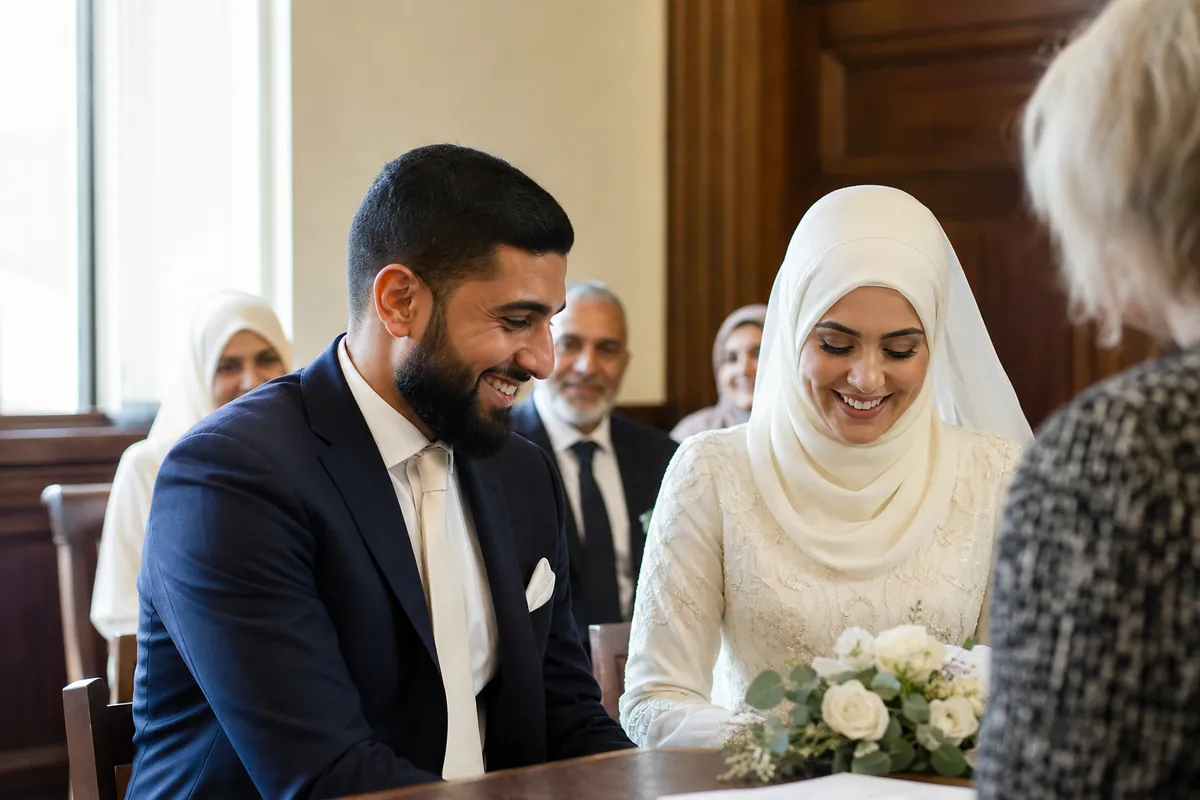
Muslim marriages in the UK involve two separate questions: whether the Nikah is valid in Islam, and whether the couple are legally married under UK law. This page explains the civil framework, registered mosques, giving notice, the Akhter case and the rules in each UK nation, and how couples can do both properly.
Executive Summary: Muslim Marriages in the UK
Quick Answer
A Nikah can be religiously valid without being a legal marriage. In England and Wales, a Nikah held there without civil formalities is generally a non-qualifying ceremony, giving no rights as spouses. Couples become legally married by a civil ceremony, or at a registered building with an Authorised Person, after giving notice.
What This Page Covers
The difference between religious and civil marriage, how mosques can conduct legal marriages, giving notice, recent legal changes, divorce, and the separate rules in Scotland and Northern Ireland. It is general information, not legal advice.
Our Role
Our team works only on the Pakistan side: Nikahs conducted and registered in Pakistan, the Nikah Nama and the NADRA Marriage Registration Certificate (MRC). We do not arrange UK ceremonies or give UK legal advice.
Fee Basis and Timing
For Pakistan-side work connected with Muslim marriages in the UK, the fee is quoted after both partners' documents are reviewed. Timing is usually a matter of weeks, depending on attestation, availability and registration; never guaranteed.
How to Start
Message us on WhatsApp at +92 316 6644789 or email info@onlinenikah.co.uk. We are advocate-led since 1985, with Pakistan offices in Karachi (Gulistan-e-Jauhar (head office) and DHA Phase 7) and Islamabad. Calls are answered 10 am to 10 pm PKT, and WhatsApp runs 24/7.
Religious and Civil Status in Muslim Marriages in the UK
The table compares the main forms that Muslim marriages in the UK take. It reflects the general position in England and Wales; the facts of a particular case, and the rules in Scotland and Northern Ireland, can change the answer.
| Ceremony | Valid in Islam? | Legal Marriage in England and Wales? | Rights as Spouses |
|---|---|---|---|
| Nikah only, at home or in an unregistered venue | Generally yes, if conditions met | Generally no: a non-qualifying ceremony | None as spouses |
| Civil marriage at a register office, plus a Nikah | Yes, through the Nikah | Yes, from the civil ceremony | Full |
| Nikah at a registered mosque with an Authorised Person, after notice | Yes | Yes | Full |
| Nikah validly registered in Pakistan | Generally yes | Overseas marriage: may be recognised, never automatic | Depend on recognition |
The Akhter Case and Non-Qualifying Ceremonies
In Attorney General v Akhter [2020] EWCA Civ 122, the Court of Appeal held that a Nikah conducted in London, without notice or civil formalities, was a non-qualifying ceremony. It was neither a valid nor a void marriage, so the wife could not seek a divorce or financial remedies as a spouse.
The practical effect for many Muslim marriages in the UK is serious. Without a legal marriage, a partner, usually the wife, may have weaker claims over the home, maintenance, pensions and inheritance. Cohabitants have far fewer rights than spouses, whatever the length of the relationship.
Registered Mosques and Authorised Persons
A common myth about Muslim marriages in the UK is that only Church of England, Jewish and Quaker weddings can be legal religious ceremonies. In fact, a mosque can be a registered building for marriages, and if it appoints an Authorised Person, a Nikah there can also be a legal marriage once notice has been given.
Many mosques are not registered, or have no Authorised Person, so couples should ask directly before relying on the venue. Where the mosque cannot register the marriage, the couple can marry at a register office before or after the Nikah.
Giving Notice and the Marriage Schedule for Muslim Marriages in the UK
In England and Wales, each partner normally gives notice in person at the register office for the district where they have lived for at least seven days. The marriage can generally take place no sooner than 28 days after notice. Partners subject to immigration control may face extra checks.
Since 4 May 2021, marriages in England and Wales are registered through a marriage schedule or document signed at the ceremony and entered on an electronic register, replacing paper register books. The schedule must reach the register office for the marriage to be registered.
Muslim Marriages in the UK: England and Wales, Scotland and Northern Ireland
The three legal systems of the UK handle religious ceremonies differently, so the right route for Muslim marriages in the UK depends on where the couple marry. The table gives the broad picture; check the current rules with the relevant registration service.
| Nation | Notice | Religious Ceremony as Legal Marriage |
|---|---|---|
| England and Wales | Normally at least 28 days | At a registered building with an Authorised Person |
| Scotland | Normally at least 29 days | By an approved religious celebrant, after notice |
| Northern Ireland | Normally at least 28 days | By an authorised religious officiant, after notice |
In Scotland, the law focuses on the celebrant rather than the building, so a Nikah conducted by an approved imam after notice can be a legal marriage. Northern Ireland has its own registration rules; couples there should check with their local registrar.
What the Evidence Says About Unregistered Nikahs
Research on Muslim marriages in the UK suggests unregistered Nikahs are common. A widely reported 2017 survey of Muslim women found that a majority of respondents' Nikahs had no accompanying civil marriage, and Cardiff University research on sharia councils in 2011 found many women seeking an Islamic divorce had never married civilly.
These figures come from limited samples and should be read with care, but they explain why lawyers, scholars and community groups encourage couples to register Muslim marriages in the UK as civil marriages too.

Talaq, Khula and Civil Divorce in Muslim Marriages in the UK
A religious divorce, whether talaq or khula, does not end a UK civil marriage. A civilly married couple also needs a divorce under the Divorce, Dissolution and Separation Act 2020, which introduced no-fault divorce in England and Wales from April 2022.
A talaq pronounced in the UK is not recognised as a legal divorce there. A divorce obtained in Pakistan through proceedings, such as notice to the Union Council Arbitration Council under section 7 of the Muslim Family Laws Ordinance, may be recognised under the Family Law Act 1986 if its conditions are met.
Law Reform: Checked 15 November 2026
The Law Commission's 2022 report, Celebrating Marriage: A New Weddings Law, recommended moving from a building-based to an officiant-based system. A Ministry of Justice consultation on weddings law ran from 16 July to 24 September 2026. At the date checked, the current rules described on this page still apply.
Doing Both: A Nikah in Pakistan and a UK Civil Marriage
Many families want the Nikah in Pakistan with relatives present. A Nikah validly registered there is assessed in the UK as an overseas marriage, generally recognised if both partners had capacity, but not automatically, especially where a proxy or online element is involved.
Couples planning Muslim marriages in the UK and in Pakistan often do both: a UK civil marriage for legal certainty and a registered Nikah in Pakistan. A later UK civil ceremony takes effect from its own date and does not backdate the Nikah. Take advice from a UK family or immigration solicitor on the order.
Nikah Nama and Registration: Our Pakistan-Side Role in Muslim Marriages in the UK
We previously had two UK offices but currently have no physical office in Britain. For Muslim marriages in the UK where the Nikah takes place in Pakistan, our team handles the practical side:
- Coordinating the Nikah Khawan, the officiant, and suitable witnesses.
- Preparing the Nikah Nama, Pakistan's official marriage contract form, in Urdu with English where needed.
- Guiding Union Council registration and the NADRA MRC.
- Explaining translation, attestation and apostille for documents used in Britain.
What We Do Not Claim
- That a Nikah alone is a legal marriage in England and Wales.
- That a Pakistani Nikah is automatically recognised in the UK or guarantees a visa.
- That we arrange UK ceremonies or give UK legal or immigration advice.
Frequently Asked Questions
Is a Nikah alone a legal marriage in England and Wales?
Generally not, and this is the central point about Muslim marriages in the UK. Attorney General v Akhter [2020] EWCA Civ 122 treated a Nikah without notice or civil formalities as a non-qualifying ceremony, giving no divorce or financial-remedy rights as spouses. Couples normally need a civil marriage, or a ceremony at a registered building with an Authorised Person, after giving notice.
Can a mosque perform a legally valid marriage?
Yes, if the mosque is a registered building for marriages and an Authorised Person is present, after the couple have given notice. Many mosques are not registered, so ask before relying on the venue. Otherwise, a register office marriage can be held before or after the Nikah.
How much notice is needed to marry in England and Wales?
Each partner normally gives notice in person at the register office for the district where they have lived for at least seven days. The marriage can generally take place no sooner than 28 days later. Extra checks may apply where a partner is subject to immigration control.
Are the rules different in Scotland?
Yes. Scotland focuses on the celebrant rather than the building, so a Nikah conducted by an approved religious celebrant after notice can be a legal marriage. Notice is normally given at least 29 days before. Check current requirements with National Records of Scotland or the local registrar.
What about Northern Ireland?
Northern Ireland has its own marriage law and registration system. Notice is normally given at least 28 days before, and a religious ceremony by an authorised officiant can be a legal marriage. Couples should confirm current requirements with their local registrar before planning Muslim marriages in the UK there.
Does a talaq end a UK civil marriage?
No. A religious divorce, whether talaq or khula, does not end a civil marriage in the UK. The couple also need a civil divorce through the courts. A talaq pronounced in the UK is not recognised there as a legal divorce.
Can we have the Nikah before the civil marriage?
Yes, many Muslim marriages in the UK happen that way, but until the civil marriage takes place the couple are generally not legally married in England and Wales. Holding both close together reduces the period without legal protection. A later civil ceremony takes effect from its own date and does not backdate the Nikah.
Is a Nikah in Pakistan recognised in the UK?
A marriage validly celebrated in Pakistan is generally recognised if both partners had capacity, but not automatically. Proxy or online elements raise questions about the place of celebration, and the Home Office examines spouse-visa evidence closely. Take advice from a UK family or immigration solicitor.
Do you arrange civil marriages or Nikahs in Britain?
No. Our role in Muslim marriages in the UK is limited to the Pakistan side: Nikahs conducted and registered in Pakistan, the Nikah Nama and the NADRA certificate. For UK ceremonies, contact a register office or a registered mosque; for legal advice, a UK solicitor.
What is the minimum age to marry?
In England and Wales, the minimum age to marry is 18, with no exceptions for parental consent. In Pakistan, both partners must meet the legal age of the province where the Nikah takes place; Sindh, for example, sets 18 for both. Free consent is always required.
Reviewed by: Syed Mohsin Ali Shah, Advocate (practising since 1985)
Last updated: 15 November 2026
General information under Pakistani law. UK and UAE recognition, visa and family-law questions should be checked with a qualified lawyer in that country.